"Do we detect ransomware?" is a question no security team can answer with a simple yes. Ransomware is not one action but a sequence: initial access, execution, privilege escalation, discovery, lateral movement, and finally encryption. MITRE ATT&CK gives a common language to break attacks into those steps, so detection can be measured step by step.
What ATT&CK is
MITRE ATT&CK is a publicly available knowledge base of adversary behaviour, based on real-world observations. It is organised in three levels:
- Tactics: the attacker's goal at a given moment, such as Initial Access, Credential Access or Exfiltration. The Enterprise matrix has 14 tactics.
- Techniques: how the goal is achieved, for example T1110 Brute Force or T1003 OS Credential Dumping.
- Sub-techniques: more specific variants, such as T1110.003 Password Spraying.
Each technique has an identifier, a description, examples of groups and software that used it, data sources that can reveal it, and suggested mitigations. MITRE publishes new versions regularly, adding and refining techniques.
Why it matters for defenders
ATT&CK turns vague goals into measurable ones. Instead of "improve detection", a team can say "we detect 6 of the 9 credential-access techniques most relevant to us, and we will add the other 3 this quarter". It also gives engineers, analysts, managers and auditors one shared vocabulary.
Mapping your rules
Start with an inventory of your detection rules and tag each one with the technique it detects. A rule can map to more than one technique, and a technique usually needs several rules for different data sources.
- Export your SIEM rules with their logic.
- Tag each rule with ATT&CK technique identifiers.
- Note the data source each rule depends on.
- Mark rules that have never fired, or never been tested.
The result is usually surprising: a cluster of rules around a few well-known techniques and large empty areas elsewhere.
Prioritise: not every technique matters equally
Covering the full matrix is neither realistic nor necessary. Prioritise techniques that:
- are used by threat groups targeting your sector;
- appear in common ransomware and intrusion chains;
- target the systems you actually run (cloud identity, Windows domain, web applications);
- can be detected with data you already collect.
Threat intelligence helps here: platforms that track threat actors and the techniques they use show which parts of the matrix deserve attention first.
From "mapped" to "proven"
A rule tagged with T1558.003 Kerberoasting is a claim, not evidence. The rule may have a typo, depend on a field the parser does not produce, or be disabled. Coverage only counts when it has been tested.
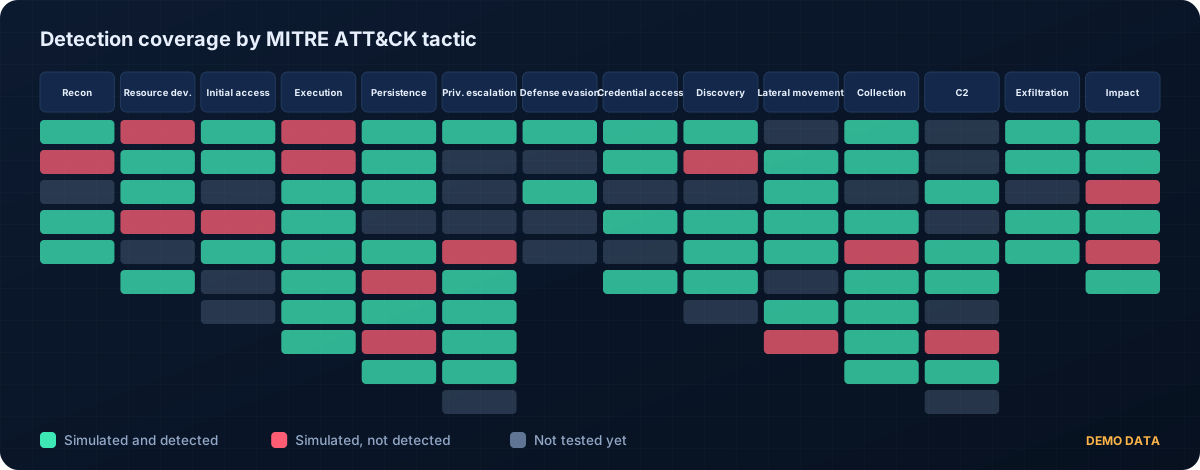
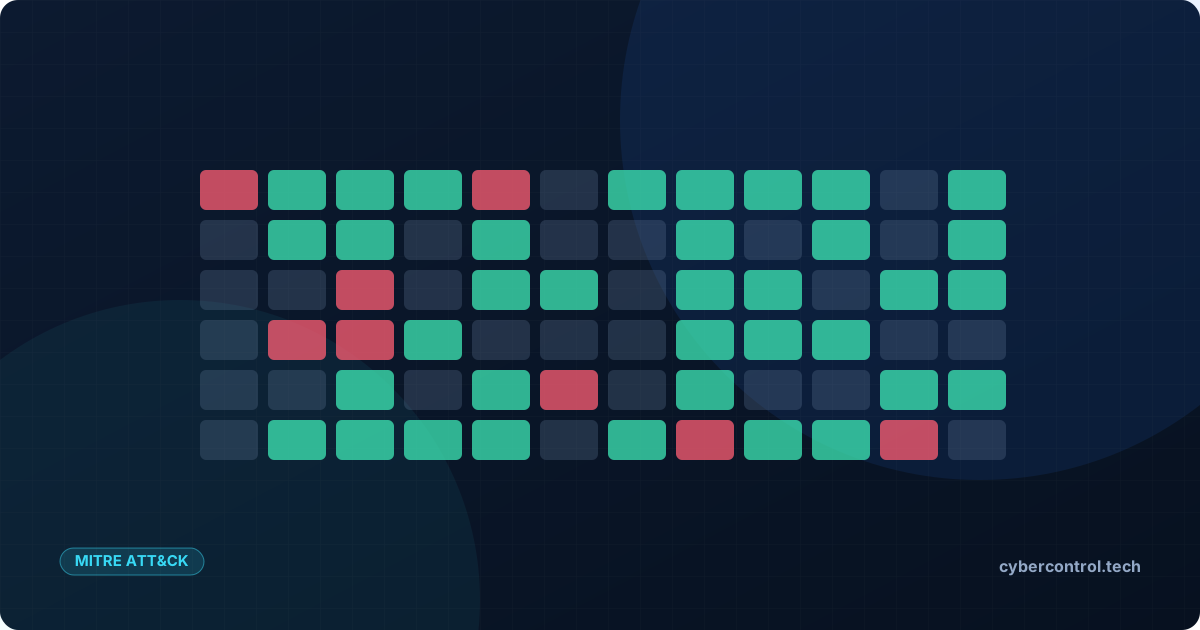
A detection-testing campaign replays one scenario per technique and records three outcomes for each: detected, simulated but missed, and not yet tested. The map above is the kind of picture that results: it shows exactly where to invest next.
APEX JediSyslogger tags each of its 90 scenarios and its 54 built-in detection rules with the ATT&CK technique they represent, which makes this comparison straightforward.
Common pitfalls
- Counting rules instead of techniques: twenty rules for one technique do not cover a second one.
- Mapping without data sources: a rule for a technique whose logs you do not collect will never fire.
- One-off exercises: coverage decays as systems, parsers and attackers change. Re-test on a schedule and after every major change.
- Treating ATT&CK as a checklist: it describes behaviour, not a complete list of every attack. Use it to structure thinking, not to replace it.
Key takeaways
- ATT&CK breaks attacks into tactics and techniques that can be measured.
- Map every rule, prioritise the techniques that matter to you, and test them.
- A coverage map backed by test results is the best evidence of detection capability you can show management or auditors.