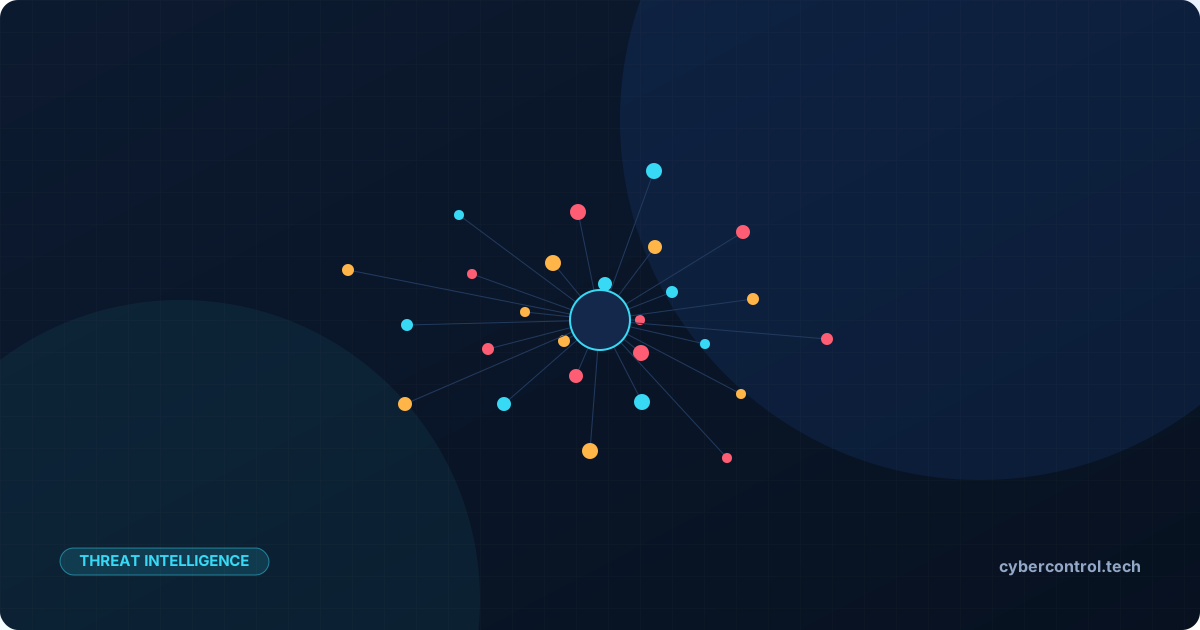
Threat intelligence is information about threats that helps an organisation make better security decisions. That last part is the important one. A list of a million malicious IP addresses is data; knowing that one of them contacted your mail server yesterday, and that it belongs to an active phishing campaign, is intelligence.
Three levels of threat intelligence
- Strategic: trends, threat actors and their motivations, for management and risk decisions.
- Operational: campaigns and attacker methods, often described with MITRE ATT&CK techniques.
- Tactical: concrete indicators of compromise that tools can match automatically.
Most organisations start with the tactical level because it plugs directly into firewalls, mail gateways and SIEMs. The other levels decide which indicators deserve attention.
Types of indicators of compromise
| Indicator | Example | Lifetime |
|---|---|---|
| IP address (IPv4/IPv6) | 203.0.113.45 | Short: addresses are reassigned quickly |
| Domain | login-example.com | Medium |
| URL | https://example.com/invoice.php | Short to medium |
| File hash (MD5, SHA-1, SHA-256, SHA-512) | SHA-256 of a malicious document | Long for that exact file |
| Vulnerability (CVE) and weakness (CWE) | CVE identifiers | Long |
Indicators near the bottom of the "pyramid of pain" (hashes, IPs) are easy to collect but easy for attackers to change. Behaviours and techniques are harder to change, which is why indicator matching should complement behavioural detection, not replace it.
Where indicators come from
Public and community sources include government catalogues such as CISA KEV, malware and URL databases such as those run by abuse.ch, community platforms such as AlienVault OTX, vendor advisories, and sharing standards such as STIX (the data format) and TAXII (the transport). Commercial services add reputation scores and analysis.
Why raw feeds create noise
Connecting dozens of feeds directly to a firewall or SIEM usually creates more problems than it solves:
- Duplicates: the same indicator appears in several feeds with different labels.
- Stale data: IP addresses that were malicious last month may now belong to a legitimate service.
- No context: an indicator without a source, date or campaign cannot be judged.
- False positives: shared hosting and content-delivery networks put good and bad sites on the same addresses.
Enrichment and context
Enrichment answers the questions an analyst would ask about an indicator: how many sources report it, what reputation services say, where it is located, what it resolves to, and which campaign or actor it belongs to.
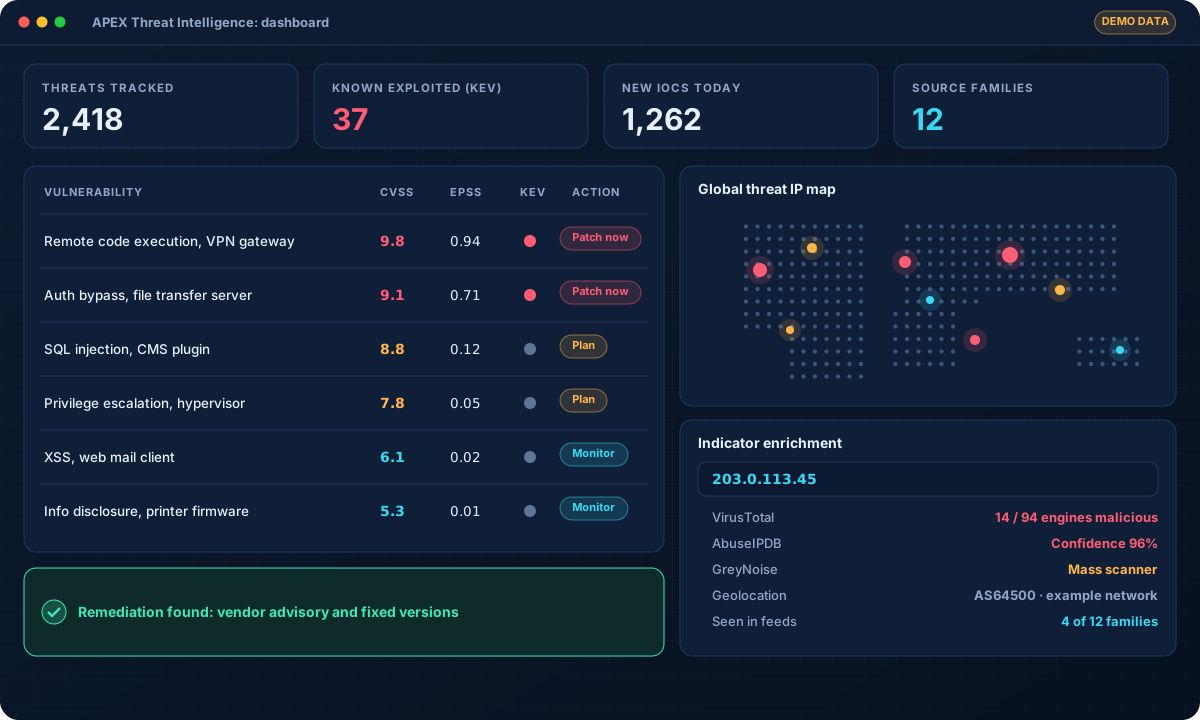
APEX Threat Intelligence stores each indicator once, records every feed that reported it, and enriches it with services such as VirusTotal, AbuseIPDB, GreyNoise and ipinfo geolocation. Its Threat Hunt view shows how many feeds report the same indicator, which is one of the quickest ways to separate signal from noise.
Putting intelligence to work
- Match against your logs: search recent firewall, DNS and proxy logs for high-confidence indicators.
- Block selectively: block indicators with strong, recent, multi-source evidence; monitor the rest.
- Expire indicators: give each type a lifetime and remove old entries automatically.
- Feed vulnerability management: exploited CVEs from intelligence sources should move straight to the top of the patch list.
- Close the loop: record which indicators produced real findings and favour those sources.
Key takeaways
- Intelligence is data with context that leads to a decision.
- Indicators are useful but short-lived; behaviours last longer.
- De-duplicate, enrich and expire indicators before they reach blocking tools.
- Count sources: an indicator reported by several independent feeds deserves more trust.