
Vulnerability prioritisation with CVSS, EPSS and CISA KEV
Why CVSS alone is a poor guide to patching, what EPSS and the CISA Known Exploited Vulnerabilities catalogue add, and a simple method to decide what to fix first.
Read the article
Threat intelligence platform
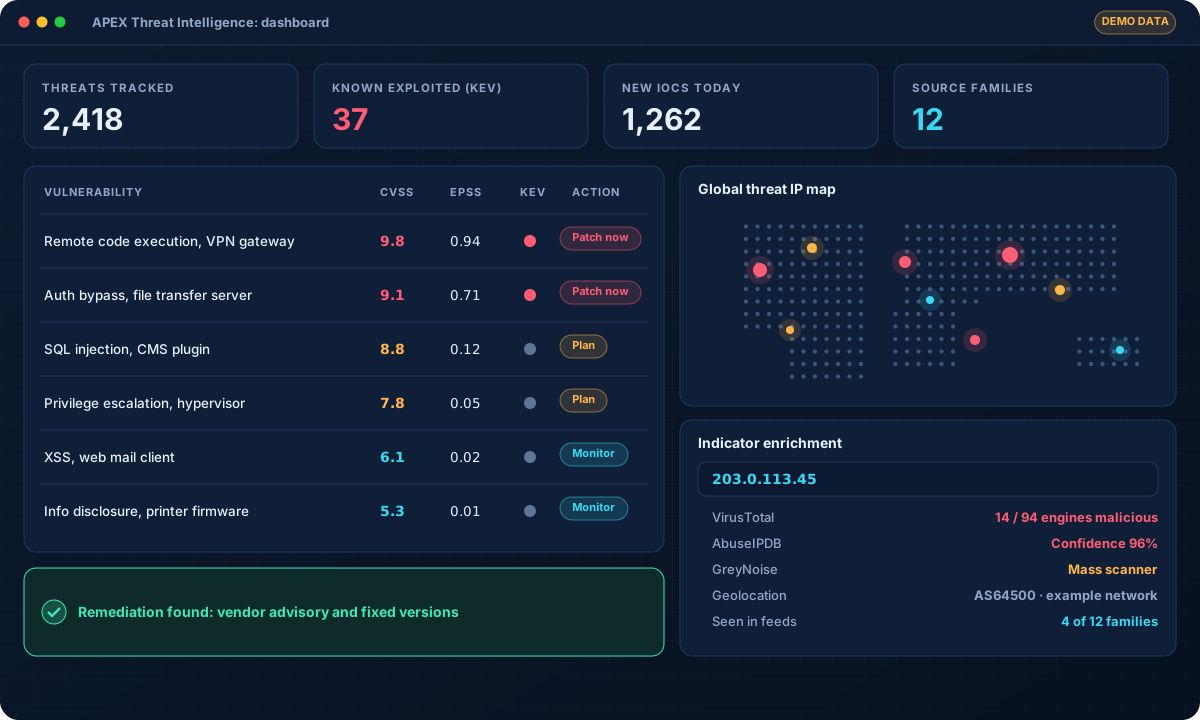
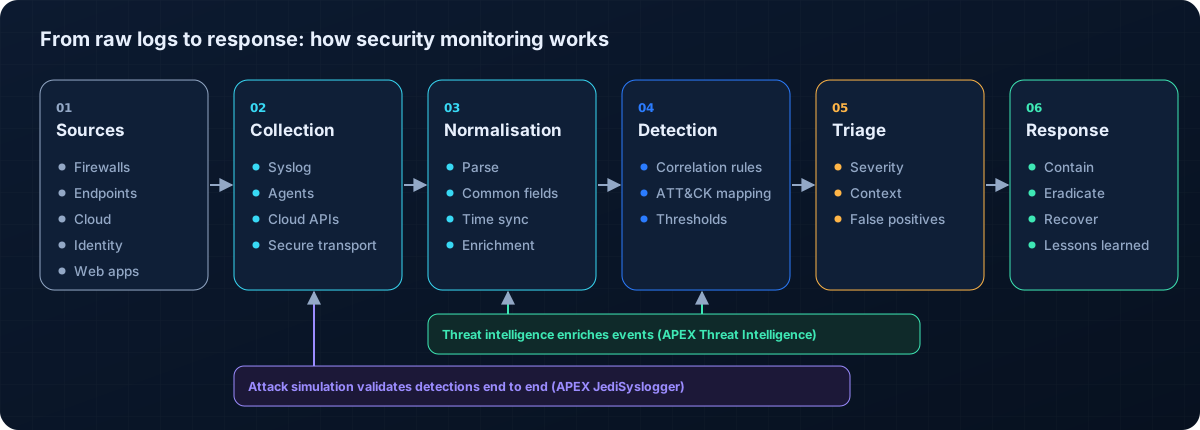
APEX Threat Intelligence collects vulnerabilities, exploited CVEs, indicators of compromise and threat-actor information from public and commercial feeds, enriches them with context and links each one to remediation advice, so analysts stop jumping between dozens of sites.
Overview
Security teams read CISA advisories, NVD entries, vendor bulletins, malware databases and community feeds every day. Each source has its own format, and the same threat appears in several of them. The result is hours of copy-and-paste and decisions made without the full picture.
APEX Threat Intelligence brings those sources together. It stores every threat, CVE and indicator once, records which feeds reported it, enriches it with severity, exploitation likelihood and reputation data, and searches automatically for vendor advisories and fixes.
Cybercontrol uses it every day to tell customers which vulnerabilities and indicators matter for their technology. Organisations with their own analysts can run it for their team.
Capabilities
Every capability below exists in the current version of the product.
Scheduled collectors read 12 source families and store each item once, with its sources.
A CVE catalogue built from the CVE Project data, enriched with the sources analysts rely on.
New CVEs often have no score for days. The product computes an effective score from the CNA score, then NVD, then an AI estimate when neither exists yet.
IPv4, IPv6, domains, URLs, MD5, SHA-1, SHA-256 and SHA-512 hashes, plus CVE and CWE identifiers, enriched from reputation services.
A catalogue of threat actors validated with AI, discovered from stored content and web search, with named incidents.
For each threat, the product searches for vendor advisories, patches and workarounds and ranks results from trusted domains first.
A global threat IP map on the dashboard places malicious infrastructure by geolocation, with markers coloured by severity.
Role-based access, mandatory two-factor authentication and a read-only REST API for your own tools.
Inside the product
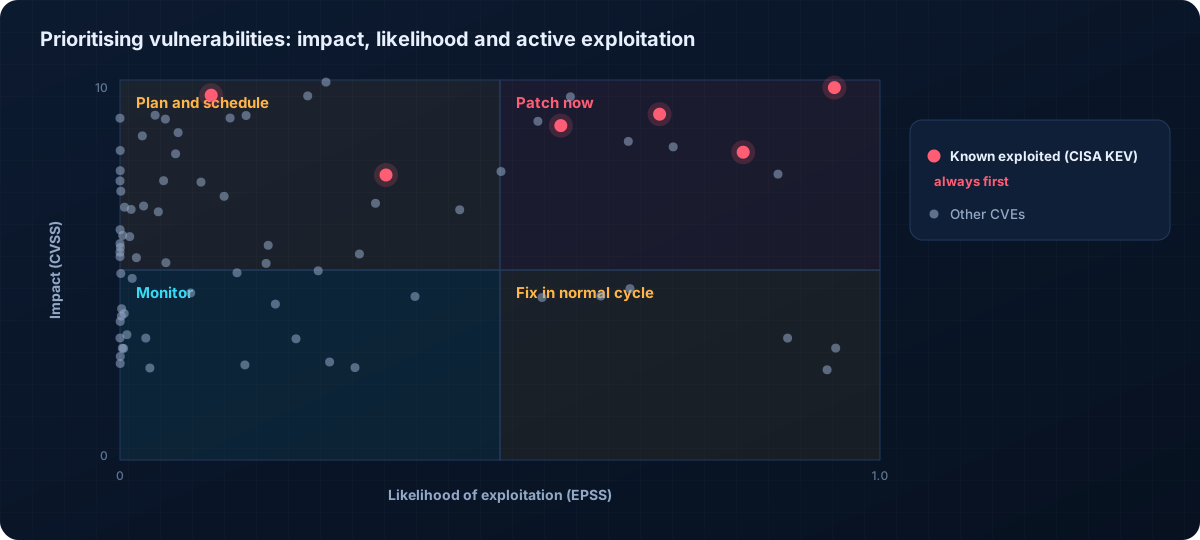
Severity alone is a poor guide: most high-scoring vulnerabilities are never exploited. The product shows impact, exploitation likelihood and confirmed exploitation side by side.
Use cases
Decide which vulnerabilities to fix this week, based on exploitation in the wild rather than score alone.
Check an IP, domain, URL or file hash against many reputation sources in one place during triage.
Prepare weekly briefings on new exploited CVEs, campaigns and actors for management and IT teams.
Use the indicator collection and API to enrich detections and block known-bad infrastructure.
Specifications
Deployment and integration details of the current version (1.0).
Use it through our managed threat-intelligence service, operated and updated by us.
Installed on your Linux servers, with your database and your API keys for the enrichment services.
| Sources | 12 collector families plus VirusTotal; additional plain-text feeds by URL or CSV |
|---|---|
| CVE enrichment | NVD CVE 2.0, CISA KEV, EPSS, ENISA EUVD (CVSS v4), cve.org/MITRE, MSRC, Rapid7, Tenable |
| Indicator types | IPv4, IPv6, domain, URL, MD5, SHA-1, SHA-256, SHA-512, CVE, CWE |
| Enrichment services | VirusTotal, MetaDefender, AbuseIPDB, GreyNoise, UrlVoid, DomScan, ipinfo.io |
| AI | Ollama (local) or Anthropic Claude; the conversational assistant requires Claude |
| API | Read-only REST API, /api/v1 (health, threats, IOCs, search, scanner profiles) |
| Access control | Admin and collaborator roles, mandatory TOTP 2FA, bcrypt password hashing |
| Database | SQLite or PostgreSQL |
| Deployment | Web application on Linux servers, single node or primary with replica |
| Not included | Push notifications, report exports and single sign-on are not part of the current version |
APEX Threat Intelligence
Public sources such as CISA KEV, NVD and EPSS work without keys. Enrichment services such as VirusTotal, AbuseIPDB or GreyNoise use your own API keys, subject to their licences.
Not in the current version. Analysts work in the console, and Cybercontrol's managed service turns relevant findings into notices for customers.
Yes. With Ollama the models run locally on your infrastructure. Anthropic Claude is optional and needed only for the conversational assistant.
Yes, through the read-only REST API, which returns threats, indicators and search results as JSON.
Resources
Why CVSS alone is a poor guide to patching, what EPSS and the CISA Known Exploited Vulnerabilities catalogue add, and a simple method to decide what to fix first.
Read the article
What threat intelligence is, the main types of indicators of compromise, why raw feeds create noise, and how enrichment, de-duplication and context turn them into decisions.
Read the article
A practical guide to MITRE ATT&CK: tactics, techniques and sub-techniques, how to map SIEM rules to them, and how to build a coverage map that shows what you really detect.
Read the articleBook a demo and we will show which current threats and exploited CVEs concern the products you use.
Contact
Tell us about your company and what worries you. A specialist will reply with next steps and, if you want, schedule a free initial assessment or a product demo.