An expired certificate is one of the most avoidable causes of downtime, and one of the most common. When it happens, browsers show a full-page warning, APIs refuse to connect and customers assume the site has been hacked. Monitoring certificates from the outside is simple, cheap and prevents a whole class of incidents.
What TLS does
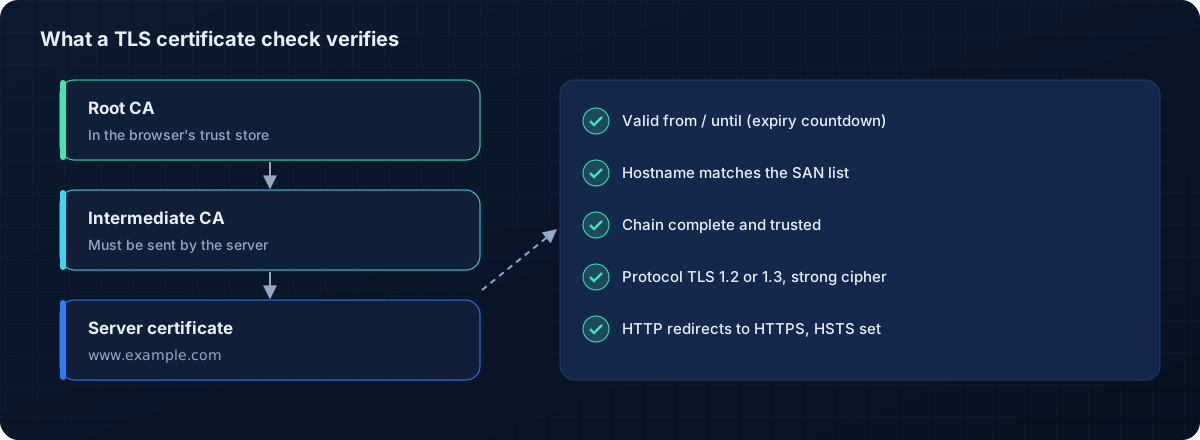
Transport Layer Security encrypts traffic between a client and a server and lets the client verify that it is talking to the right server. Verification relies on a certificate chain: the server's certificate is signed by an intermediate certificate authority, which is signed by a root authority the client already trusts.
Why certificates still cause outages
- Manual renewals are forgotten when the person who set them up leaves.
- Automation fails silently: a renewal job breaks after a DNS or firewall change and nobody notices for weeks.
- Copies drift: the new certificate is installed on one load balancer but not on the others.
- Incomplete chains: the server sends its certificate without the intermediate; some clients work, others fail.
Certificate lifetimes are also getting shorter. The CA/Browser Forum has approved a schedule that reduces the maximum validity of public TLS certificates in steps, from 398 days down to 47 days by 2029. Shorter lifetimes reduce risk, but they make reliable automation and monitoring essential.
What to check, beyond the expiry date
| Check | Why it matters |
|---|---|
| Days until expiry | Time to act before customers see warnings |
| Chain completeness | Missing intermediates break some clients |
| Hostname match and SANs | The certificate must cover every name the site uses |
| Issuer | Unexpected issuers can reveal misconfiguration or interception |
| Protocol versions | TLS 1.0 and 1.1 are deprecated; TLS 1.2 and 1.3 should be used |
| Cipher | Weak ciphers undermine encryption |
| HTTP to HTTPS redirect and HSTS | Prevent users from staying on unencrypted HTTP |
A good monitor reads the certificate even when it is invalid, so it can tell you what is wrong instead of only that something is wrong.
Monitor from the outside
Internal checks can pass while customers fail: a firewall rule, a CDN configuration or a different certificate on another node may be in their path. External monitoring connects the way a customer does and records what it sees.
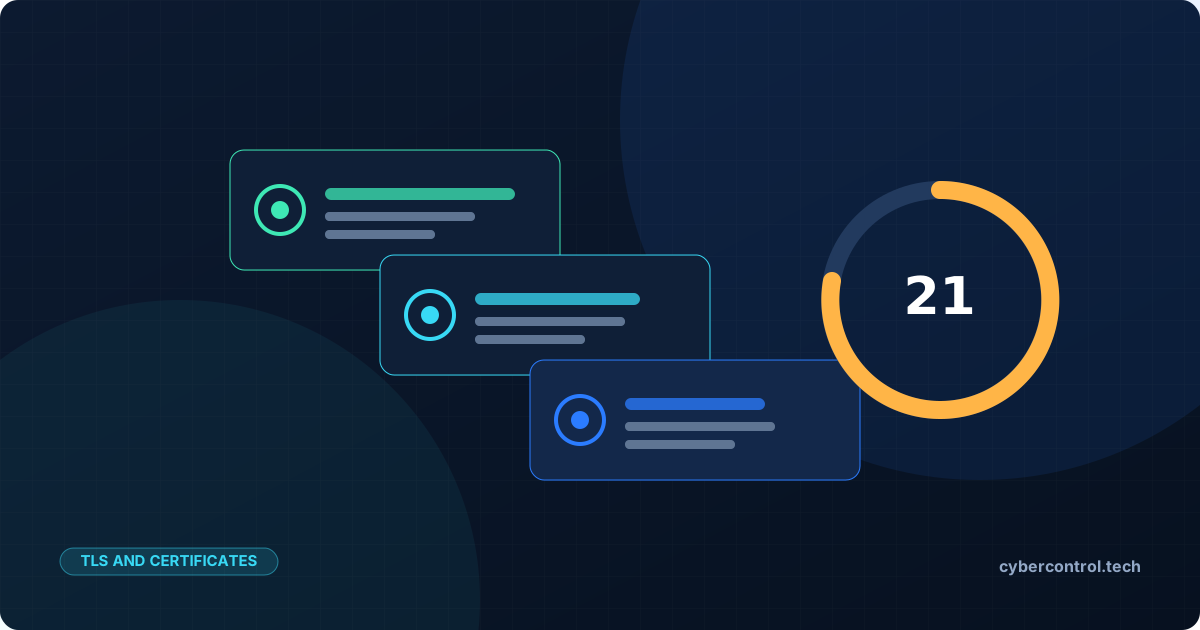
APEX Pingmora checks each site on a schedule, reads the full certificate including expiry, issuer, key, protocol, cipher, chain, hostname and alternative names, and lists certificates that need attention on its dashboard. The default warning window is 21 days and can be changed from 1 to 365 days. It also checks HTTP and HTTPS separately, including the redirect, HSTS and HTTP/2 support.
A simple certificate routine
- Inventory every public hostname, including APIs, mail and old marketing sites.
- Automate renewal wherever possible, with ACME clients and alerts on failure.
- Monitor externally every hostname, with a warning window that leaves time to act.
- Check every node behind a load balancer, not only the address users resolve.
- Review protocols and ciphers at least once a year and after platform changes.
Key takeaways
- Expired certificates are avoidable outages.
- Check the chain, names, protocols and redirects, not only the date.
- Shorter certificate lifetimes make automation and monitoring essential.
- Monitor from the outside, the way your customers connect.